

📄 Paper Walkthrough
Fletch: File-System Metadata Caching in Programmable Switches Qingxiu Liu, Jiazhen Cai, Siyuan Sheng, Yuhui Chen, Lu Tang, Zhirong Shen, Patrick P. C. Lee arXiv:2510.08351v3 · May 2026 · 17 pages Code: https://github.com/adslabcuhk/fletch
TL;DR
Fletch moves HDFS metadata caching from clients into the programmable switch’s data plane, compiles it to a Tofino chip via P4, and serves metadata requests directly on the network’s critical path. It drops cache-coherence complexity from O(N) to O(1) and uses in-switch centralization to absorb hot requests and fix load imbalance on the backend.
Why Fletch
- 67–96% of filesystem requests in Baidu AI Cloud are metadata operations. In Yahoo’s HDFS clusters, 3% of files serve 34–39% of requests — extreme access skew.
- Three pain points of client-side caching:
- Consistency maintenance is O(N): every write must notify all clients.
- Client caches are siloed and can’t cooperate to fix load imbalance.
- Existing schemes (IndexFS, InfiniFS) only cache directory permissions; attribute reads still go to servers.
- Programmable switches flip the picture: they sit on every client↔server path, so centralization fixes both problems at once — O(1) consistency and natural hot-spot absorption.
Three Core Techniques
| Technique | What it does |
|---|---|
| Path-aware cache management (§IV) | Caching a path caches its ancestors too; uses Count-Min Sketch for frequency estimation; eviction is “least-frequent, no descendants, recurse up” |
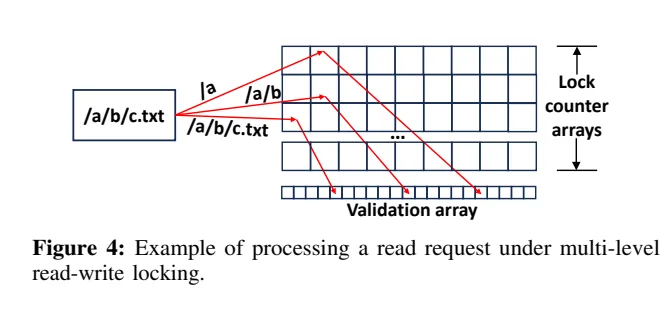
| Multi-level read-write locking (§V) | 8 lock counter arrays (one per path level), 64K × 16-bit slots each; 1-bit validation flag; PHV processed level by level via recirculation |
| Local hash collision resolution (§VI) | 64-bit MD5 + 8-bit token per path; controller syncs (hash, token) to switch / server / client so collisions resolve locally |
Multi-level Locking: P4 Pseudocode
The following is P4-style pseudocode derived from §V. P4_16 has no loops or recursion; multi-level path resolution is implemented via packet recirculation (one level per pass).
Data structures
// === Lock counter arrays: 8 banks, 64K slots × 16-bit each ===
register lock_array_1 { Width: 16; Size: 65536; }  // level 1: /a
register lock_array_2 { Width: 16; Size: 65536; }  // level 2: /a/b
register lock_array_3 { Width: 16; Size: 65536; }  // level 3: /a/b/c
// ... 7 banks; level 8+ share lock_array_8

// === Validation flags: 1 bit per cached path ===
register validation { Width: 1; Size: <hash_space>; }

// === Cache values ===
register cache_value_lo { Width: 32; Size: <num_slots>; }
register cache_value_hi { Width: 32; Size: <num_slots>; }
Read path (single-path reads: open / stat)
Each level: ① take lock → ② validate → ③ permission check → ④ release previous level’s lock → ⑤ either advance via recirculation or finish.
action process_level() {
    lvl = cur_level;
    idx = hash_low16_at_level(lvl);  // from PHV, precomputed by client

    valid = validation.read(idx);
    if (valid == 1) {
        lock_val = lock_array_X.read(idx);
        lock_array_X.write(idx, lock_val + 1);   // read lock: counter++

        meta = read_cache(idx);
        if (!permission_check(meta)) {
            failed = 1; fail_level = lvl;
        }
    } else {
        failed = 1; fail_level = lvl;
    }

    if (lvl > 1) release_lock(lvl - 1);

    if (cur_level < depth && !failed) {
        cur_level = lvl + 1;
        recirculate();
    } else {
        release_lock(lvl);
        if (!failed) send_response_to_client();
        else        forward_to_server();
    }
}
Write path (single-path writes: chmod / chown)
action process_write() {
    idx = hash_low16_at_level(depth_of_target);
    cur = lock_array_X.read(idx);
    if (cur > 0) { recirculate(); return; }  // spin-wait
    validation.write(idx, 0);                  // exclusive
    forward_to_server();                       // write-through
}

action on_write_response() {
    if (success) update_cache(idx, new_metadata);
    validation.write(idx, 1);
    // sequence number protocol prevents ACK loss causing double decrement
    send_ack_to_server();
}
Writer starvation (paper-acknowledged limitation): the design is reader-preferring. While a write recirculates waiting for the counter to drop to zero, new reads keep incrementing it, so the writer can starve under continuous read load.
Multi-path writes (chmod -R): top-down ordering
The parent’s validation flag stays at 0 until every cached descendant has been updated. Any in-flight reads blocked by validation=0 are forwarded to the server, so they never see a mix of “parent updated, children not yet”.
How “loops” map to P4
| Logical loop | P4 implementation |
|---|---|
| Iterate level 1..depth | Each PHV recirculates up to depth + 1 times |
| Pick the right lock_array per level | Ingress if-else on cur_level |
| Each memory block accessed once per traversal | Place lock_array / validation / cache_value in different pipeline stages |
Key Numbers (128 simulated servers)
| Workload | Fletch vs NoCache | Fletch+ (with client cache) vs CCache |
|---|---|---|
| Alibaba | +11.0% | +14.7% |
| Training | +134.6% | +103.6% |
| Thumb | +181.6% | +139.6% |
| +71.2% | +57.3% |
- Latency (read-heavy @ 0.26 MOPS): Fletch cuts NoCache’s avg / p95 / p99 by 64.6% / 89.8% / 87.7%.
- Switch resources: SRAM 58.4% / Stage 100% / ALU 98% / PHV 93% — slightly more than NetCache / FarReach, but within budget.
- Recovery: server 0.5–2.1 s / controller < 40 ms / switch 14.6–75.5 s (slowest, replays admission per path).
Paper-acknowledged limitations
- Writer starvation under reader-preferring locking
- Write-heavy workloads degrade beyond ~50% chmod
- PHV at 93% leaves little headroom for new features
- Strong assumption: root is permanently cached, root permissions immutable
- Multi-switch topology is not addressed — only a single Tofino is evaluated
My take
The idea is right, the implementation is complete, and the evaluation is solid. Two engineering red flags worth noting:
- Writer starvation is a real production risk — any workload with non-trivial chmod / rename traffic could stall.
- PHV at 93% is uncomfortably close to the hardware ceiling; any future feature hits the wall.